|
Perth airmen survived notorious German camp By Chris Must, Perth
EMC EMC News Code, who passed away April 24 at the age of 90, was buried at Elmwood Cemetery May 22. He was one of a small handful of Perth residents who were shot down in bombing missions, captured, and held prisoner at Stalag Luft 3, scene of the infamous Great Escape in March 1944. Code spent his entire time in camp with fellow Perth resident Jimmy Kanelakos, who he met up with in a hospital. The families of both men received official word from the Royal Canadian Airforce in November, 1943 that they were prisoners of war. A contemporary newspaper account recorded that Kanelakos, a mid-upper gunner in a Lancaster bomber, had already flown 40 missions over major targets before being shot down near Hanover on Sept. 28, 1943. Kanelakos told the newspaper he had survived the German fighter attack despite being trapped inside his gun turret with a bullet in his right leg as the burning bomber spiraled toward the earth. The fighter turned back and launched a second stream of bullets. Kanelakos was hit again, but the bomber disintegrated in mid-air, freeing the trapped gunner, who managed to grab his parachute and open it. Captured and taken to a Luftwaffe hospital, Kanelakos was visited by the pilot who had shot him down. The German brought him cigarets in food, and said in broken English, I am sorry to shoot you down, but it is war. Kanelakos reached Stalag Luft 3 in Sagan (near Germanys border with Poland) in May, 1944, a short time after the famous mass escape which ended in the execution of 50 of the recaptured Allied prisoners. The
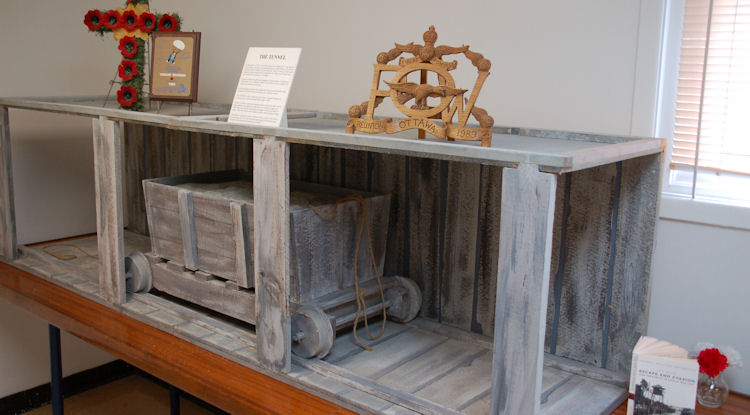
Great Escape Made for a 1989 Ex-RCAF Prisoner of War Association reunion held in Ottawa, the display is a replica of the real 350-foot tunnel. The interior working size of 24 by 24 inches was the actual measurement of the tunnel history also records that the prisoners daily ration was far below the recommended caloric intake for an active adult male. By the summer of 1943, in the north compound of Stalag Luft 3, there was a well-organized team of young officers of the Royal Air Force, Royal Canadian Air Force and other Allied air forces. The men decided to tunnel their way out off the camp. It was to be one of the most gallant and imaginative escape projects ever attempted by prisoners of war. What made this escape attempt unique was the sheer scale of the project. More than 650 Allied aircrew spent almost a full year digging three separate tunnels out of the prison camp. Their aim was to free 240 prisoners at once and spread chaos throughout Germany. The Allied forces were just concerned with them escaping; whether they got back or not was sort of secondary, said Gordon Thomas, assistant curator of the Hall of Remembrance. They had the country turned upside down looking for those prisoners, and it tied up a lot of time and manpower. The escape involved the active support of intelligence services in London, who contravened the Geneva Convention to supply the tunnellers with materials to help them escape. Throughout the spring and summer of 1943 the prisoners dug three tunnels, codenamed Tom, Dick and Harry. The work progressed at an average of three metres a day, producing 8,000 kilograms of sand every 24 hours. As depicted in the 1963 film, The Great Escape, men actually hid the dirt in bags inside their trousers and pulled strings to release it onto the ground as they walked around the compound. One unconcealed mound of dirt led German investigators to discover one of the tunnels Tom. As 1944 began the prisoner in charge of the escape committee, Roger Bushell, ordered the team to concentrate solely on Harry. Dig continued around the clock as the men used crude improvised tools and bunk bed slats. Kitbags and milk tins formed the bellows and ventilation system. The tunnel, barely enough space for a man to struggle through, was finally completed on a cold and miserable March night in 1944. It was time. One by one the airmen emerged from the mouth of the tunnel into the snow and ran for the trees. Prisoners who could speak German went out first, and the first of the few who had the best chance of making it home were given money and documentation to travel by rail. Seventy-six officers made their escape through the tunnel that night before the escape was discovered by guards. What gave them away was a guard spotting some steam from the tunnel, said Thomas. A guard fired a shot, which missed its target but alerted the rest of the escapers who were waiting to go through the tunnel. All but three of the escapers were recaptured, most within days or even hours. Within 24 Hitler issued an order to shoot them, later decided that only 50 would be shot, not out of mercy but because killing everyone would have made it obvious that they had been executed rather than killed while trying to escape. Among the prisoners who were shot were six Canadian officers: Henry Birkland, Gordon Kidder, Patrick Langofrd, George McGill, James Wernham and George Wiley. The crime outraged the Allies, but after the war the task of finding, identifying and punishing the perpetrators seemed hopeless. Nevertheless, Royal Air Force investigators tracked down 69 of the 72 Germans known to have been involved in the executions. Ten were hanged in 1948. The RAF had a pretty efficient military police organization, and they did a lot of footwork and detective work, said Thomas. They went through the Gestapo records and pieced together who was responsible for shooting the prisoners. The Germans only adhered to the Geneva Convention up to a point, he said. Generally speaking the guards were pretty decent, he added. The camp commandant was a decent person, but he was a military man. He wasnt a Nazi fanatic." |